
I flew in from Alice Springs and was met at the airport by Castaways' courtesy bus. They operate an internet booking agency, so I'd booked my accommodation and a couple of tours through them. The hostel itself is a bit out of town, but they run minibuses into the centre at regular intervals.
Cairns is the party place on the backpacker circuit. A lot of people stay there for months, working, and failing to save any money. It's a strange choice as a major tourist centre because it doesn't even have a beach. The Esplanade looks out onto mud and the mangrove swamps on the other side of the river from town are very muddy. In an effort to do something about this, they were building a “lagoon”, which I think is a fancy name for a large, outdoor swimming pool. It does have a lot of accommodation to suit just about any pocket. There are also a lot of bars and nightclubs.
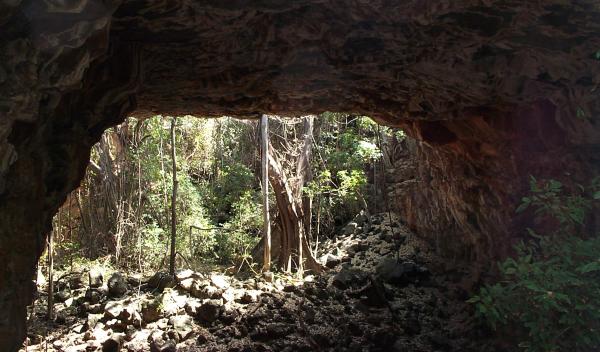 |
| One of the Lava Tubes at Undara |
One of the tours that I'd asked to be booked on was to Undara to see the lava tubes. These tubes are formed when lava flows from a volcanic eruption. The air cools the outside of the lava, which solidifies, but the lava inside continues to flow. When the eruption stops, the lava flows out of the end of the tube leaving behind a long tunnel. One of the lava flows at Undara extends for more than 100 miles (160 kms) making it the longest known single lava flow on Earth.
When I got the tickets, I found that I'd been booked on a tour operated by APT. I think it's fair to say that they cater for a certain age group and I was quite a bit younger than everyone else on the trip. The driver kept up a constant commentary for the first couple of hours. The problem was that there wasn't really that much of interest to see. First we went up a windy road, through the mountains and up to the Atherton Tablelands. These are important agriculturally, but having dairy buildings and potato fields pointed out didn't interest me in the slightest. There are some old crater lakes in the area, which might have been interesting, but we didn't stop at any of them.
The journey took about 3 hours to get there. The last hour, the landscape changed from the lush, green fields of the Tablelands to the sort of parched bush that covers much of Australia. When we arrived, the first thing we did was have a buffet lunch. Then we went off to see the tubes themselves.
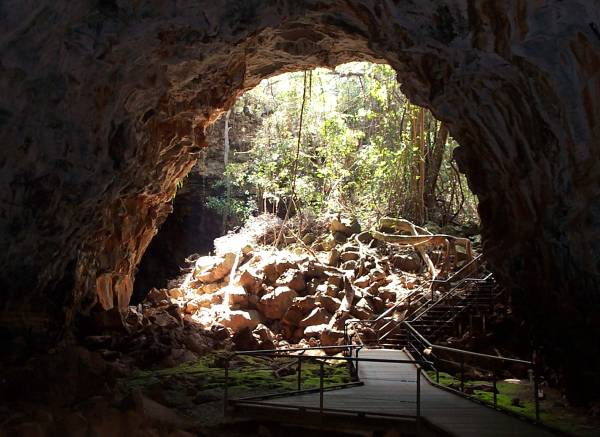 |
| Another Lava Tube at Undara |
The guide handed us a torch and we walked down some wooden steps spying a couple of rock wallabies on the way. The tubes are wide. We walked about 50 yards inside one before we came to what looked like the end. In actual fact, the tube continued on but downwards. The lava probably flowed over an old waterfall and the bottom of the cave has now filled out with mud.
We had several features pointed out to us, such as lavacicles. These look like stalactites but weren't formed by water action. Instead they occurred when the roof or an overhang dripped lava as it cooled. You could also see this on the walls in a kind of candlewax effect. Every year the area experiences a lot of rain in the wet season, so there is also a build up of mineral salts on the roof. These formations are know as “cave coral” because of their structure.
After the first cave, we wandered along to another one which was nearby and spend another 20 minutes or so inside that one. And that was it. Time was short, but even so, I did think that we could have experienced a bit more and walked around more. My impression of the day was that we spent far too much time in the bus, and far too little time in the caves themselves. You can stay at Undara. There are various accommodation options there, so that might be a better bet. The trouble is that it's not really on the way from anywhere. It might make an interesting detour if your driving from the Northern Territory to Cairns, though you would need to drive on unsealed roads for part of the way.
In addition to Undara, I'd also booked a 4 day diving trip on Taka II to the Great Barrier Reef and Coral Sea.
![[Back]](../button.return.gif) Back to Oz Index
Back to Oz Index
|
![[More]](../button.more.gif) Onto Taka II trip to GBR
Onto Taka II trip to GBR
|